

The short answer: Thunderbolt 4 and USB4 40 Gbps are practically the same speed for storage, both reaching around 3000 MB/s. USB 3.2 Gen 2 runs at 10 Gbps (about 1050 MB/s) and is more than enough for most people. What matters most: it's not your SSD that determines the speed, but the port on your laptop. So check what your laptop can do first, then choose the enclosure.
Why the same connector is so confusing
USB-C is only the shape of the connector. What runs through it depends on the standard behind it, and you can't see that from the outside. Two cables that look identical can differ in speed by a factor of four. The same goes for the port on your laptop and for the enclosure around your drive.
The good news: you don't need to be a tech expert to make the right choice. There's really only one thing you need to know, which port your laptop has, and the rest follows automatically. The Switss® USB4 / Thunderbolt 4 enclosure gets the most out of the fastest ports (up to around 3000 MB/s, both NVMe and SATA M.2, capacity up to 8 TB), while a more affordable USB 3.2 enclosure is a perfect match for a regular USB-C port.
The three standards in one table
Below are real-world figures for sequential reads with a fast NVMe drive. Write speeds are typically 10 to 20 percent lower.
| Standard | Bandwidth | Real-world speed | Connector |
|---|---|---|---|
| Thunderbolt 4 | 40 Gbps | around 3000–3500 MB/s | USB-C |
| USB4 (Gen 3×2, 40 Gbps) | 40 Gbps | around 3000–3500 MB/s | USB-C |
| USB4 (Gen 2×2, 20 Gbps) | 20 Gbps | around 1800–2000 MB/s | USB-C |
| USB 3.2 Gen 2×2 | 20 Gbps | around 1800 MB/s | USB-C |
| USB 3.2 Gen 2 | 10 Gbps | around 1050 MB/s | USB-C or USB-A |
| USB 3.2 Gen 1 (= USB 3.0) | 5 Gbps | around 450–500 MB/s | USB-C or USB-A |
Thunderbolt 4: the strictest, with guarantees
Thunderbolt 4 is Intel's standard and must be certified. That means every device with the logo meets a fixed baseline, so you know in advance what you're getting:
- Always at least 40 Gbps for data
- External NVMe storage and even external graphics cards via PCIe (at least 32 Gbps for storage)
- Drive two 4K displays or one 8K display
- Chain up to six devices together (daisy-chaining)
- Charging through the same port, often up to 100 W
You can usually recognize a Thunderbolt 4 port by a small lightning bolt icon next to the USB-C connector, sometimes with a 4 next to it.
USB4: the same top speed, but check the version
USB4 is the open successor to USB 3.2 and can be just as fast as Thunderbolt 4, but it doesn't have to be. USB4 comes in separate versions, and that's where the catch lies:
- USB4 starts at 20 Gbps; only the 40 Gbps variant (Gen 3×2) is as fast as Thunderbolt 4
- Not every USB4 version is required to offer display output or PCIe
- Cheaper to build, so you'll find it more often on mid-range laptops
If you see "USB4" listed, check whether it also says 40 Gbps or "Gen 3×2". Only then will you get the high speeds you're after.
USB 3.2 Gen 2: plenty for most people
Most external SSD enclosures work over USB 3.2 Gen 2 at 10 Gbps. In practice that's around 1050 MB/s, effortlessly enough for backups, photos, moving files between computers and everyday use. If you have a very fast NVMe drive, it will be slowed down somewhat here, but you won't notice much of that in normal use.
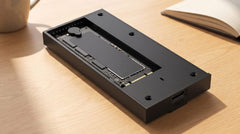
If this route suits you, the Switss M.2 SSD enclosure with heatsink is a sensible choice: NVMe and SATA, up to around 1050 MB/s, with cooling. Ideal if your laptop doesn't have Thunderbolt or USB4.
What do you really need?
Choose 40 Gbps (Thunderbolt 4 or USB4 40): you edit 4K or 6K video, regularly move large datasets, or use an external SSD as your main working drive. Condition: your laptop needs to have the port too. Then the Switss USB4 / Thunderbolt 4 enclosure is the logical choice.
Choose 10 Gbps (USB 3.2 Gen 2): everyday use, backups, quick file transfers. For most people this is exactly right.
Want two drives or extra peace of mind? With the Switss RAID Dual-Bay enclosure you fit two M.2 drives into one enclosure over USB-C 3.2 Gen 2 (20 Gbps), handy for extra storage or a safe copy.
Check what your laptop can do in one minute
Windows: open Device Manager and look under "Universal Serial Bus controllers" for "Thunderbolt" or "USB4". Intel laptops from 2021 onward almost always have Thunderbolt 4 on the USB-C port.
Mac: click the Apple menu → About This Mac → System Report → Thunderbolt/USB4. All Macs with an M-series chip have Thunderbolt 4 by default.
Rule of thumb: if your laptop is from 2021 or newer and there's a lightning bolt icon next to the USB-C port, it's likely Thunderbolt 4. Not sure? Your laptop's official product page will confirm it.
Don't forget the cable
The weakest link determines the speed. Connect a 40 Gbps enclosure to a slow port or a regular cable, and you'll drop back to that lower speed. The enclosure itself is always backward-compatible, so nothing breaks. Check two things: that your laptop port can handle the high speed, and that your cable is built for it (genuine 40 Gbps cables are usually shorter and a bit sturdier).
Conclusion
The connector looks the same everywhere, but the speed varies enormously. Let your choice be guided by your laptop's port, not the drive. If your laptop has Thunderbolt 4 or USB4 40 Gbps, the Switss USB4 / Thunderbolt 4 enclosure gets the most out of it (up to around 3000 MB/s, up to 8 TB). If you have a regular USB-C port, the Switss M.2 enclosure with heatsink delivers up to around 1050 MB/s, plenty for everyday use. Still not sure? Our Dutch customer service is happy to help, and with a 2-year warranty and 30-day returns you can choose without any risk.
Frequently asked questions
Is Thunderbolt 4 faster than USB4?
Not necessarily for storage. Thunderbolt 4 and USB4 40 Gbps both reach up to around 3000 MB/s. Thunderbolt 4 sets stricter minimum requirements and therefore offers more guarantees, but in pure data speed they're equivalent.
Does USB4 always reach 40 Gbps?
No. USB4 starts at 20 Gbps (Gen 2×2). Only the USB4 Gen 3×2 variant reaches 40 Gbps. Check the specifications for 40 Gbps or Gen 3×2.
Does a fast enclosure also work on a slower port?
Yes. A Thunderbolt 4 or USB4 enclosure is backward-compatible and works on a USB 3.2 port, but then at the speed of that port (around 1050 MB/s at Gen 2). The port on your laptop determines the ceiling.
How do I know if my laptop has Thunderbolt 4 or USB4?
On Windows, check Device Manager under Universal Serial Bus controllers; on a Mac, via About This Mac, System Report. A lightning bolt icon next to the USB-C port usually points to Thunderbolt 4. Your laptop's product page will confirm it.
Does it matter which SSD I put in the enclosure at 40 Gbps?
Yes. A slow M.2 drive becomes the bottleneck itself at 40 Gbps. Use an NVMe drive with a read speed above 3000 MB/s to actually make use of the port.